
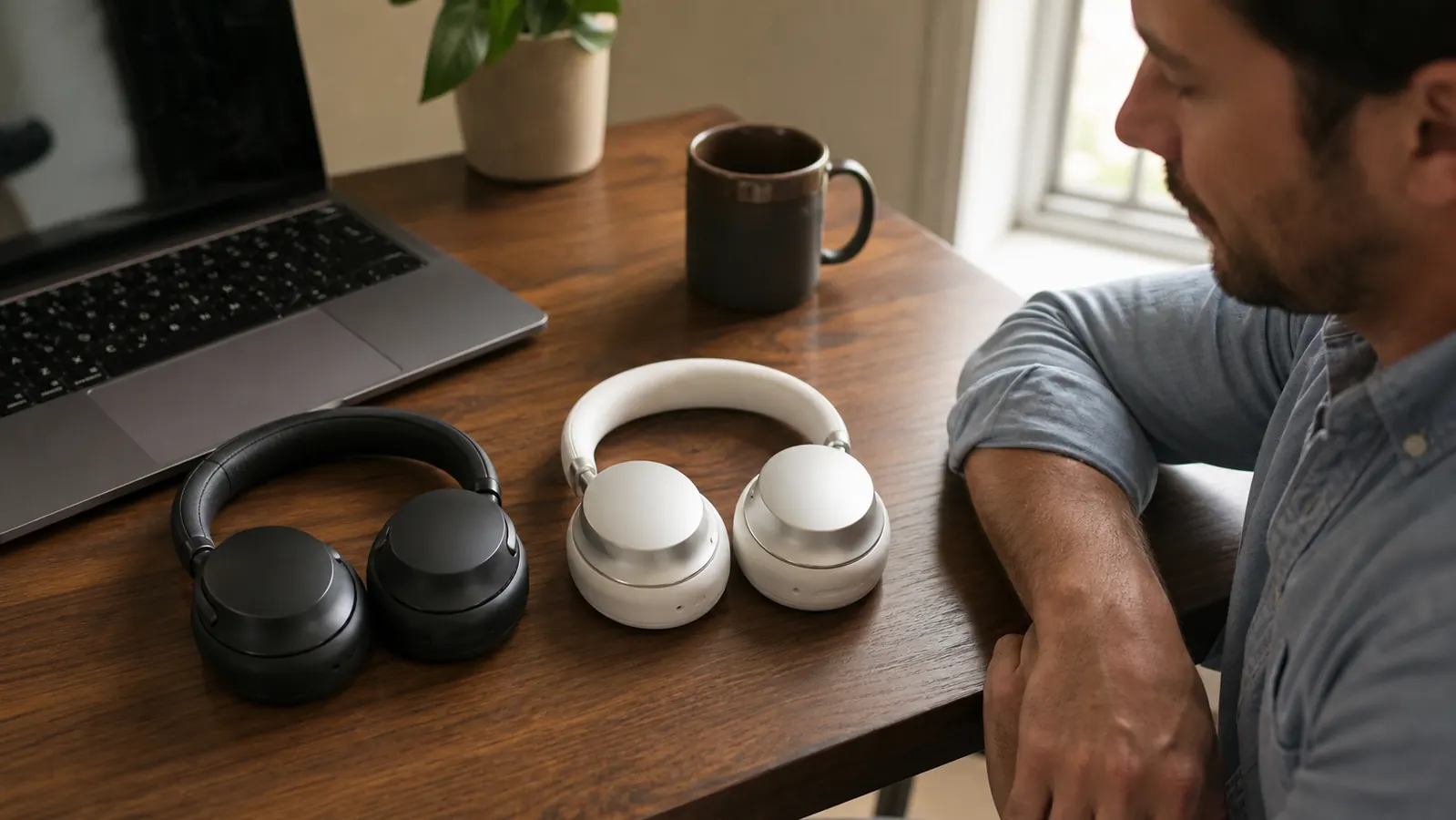
Before I bought the Soundcore Q30, I had a Bose QuietComfort 45 sitting in my Amazon cart for close to a week. I kept comparing the price to what I actually needed the headphones to do, which was mostly block out my stepson's video game headset bleeding through the wall and my dog barking at delivery trucks during 10am stand-up calls. The Bose kept winning on reputation alone. Then I actually read the spec sheets side by side instead of going on brand name, ordered the Q30, and eight months later it's still the pair I reach for every single workday.
This isn't a takedown of Bose. The QuietComfort line earned its reputation the hard way, and there are real reasons people pay the premium. But most people asking this question aren't audio engineers chasing the last five percent of noise cancelling performance, they're trying to survive a noisy household during back-to-back Zoom calls without spending three hundred dollars to do it. That's the comparison we focus on at Best Home Office Setup Hub, and it's the one most review sites skim past because they're too busy praising Bose's brand history to talk about what you actually get for the money.
So I pulled the exact numbers instead of relying on vague impressions. Price, battery life with noise cancelling on, call microphone quality, weight, app features, warranty, all of it side by side. A couple of the gaps are smaller than the price difference suggests. One or two are bigger than I expected going in.
| Soundcore Q30 | Bose QuietComfort 45 | |
|---|---|---|
| Price (typical retail) | Check today's price on Amazon | Premium tier, varies by color and retailer |
| Active Noise Cancelling | Hybrid ANC, 3 adjustable levels plus a custom mode in the app | Bose's proprietary ANC, widely considered the industry ceiling for low-frequency rumble |
| Battery Life (ANC on) | 60 hours | 24 hours |
| Weight | 10.7 oz | 8.5 oz |
| Call Microphone Quality | Clear in quiet rooms, picks up more background hiss in loud environments | Noticeably cleaner voice isolation on calls, better wind and background rejection |
| Multipoint Bluetooth | Yes, connects to two devices at once | No, single-device connection only |
| App and EQ Customization | Soundcore app with 22-band custom EQ and adjustable ANC levels | Bose Music app with basic EQ presets, less granular tuning |
| Warranty | 18-month limited | 1-year limited |
| Foldable and Case | Folds flat, comes with a hard carrying case | Folds flat, comes with a hard carrying case |
Where the Soundcore Q30 Wins
The gap that matters most for a home office budget is obvious: for about a fifth of what the QuietComfort 45 costs at full price, the Q30 gives you hybrid ANC that handles the noise sources that actually interrupt a workday. I tested it against a running vacuum in the next room, a leaf blower outside my window, and my dog's bark, and in all three cases the Q30 knocked the volume down enough that I stopped noticing mid-call. It's not silence. It's the difference between a noise being the center of your attention and being background you can tune out.
Battery life is the feature I undersell every time I recommend this pair, because on paper 60 hours sounds like a spec-sheet number nobody uses in real life. In practice it means I charge the Q30 roughly once every ten days of daily 6 to 7 hour use, and I've forgotten to charge it overnight more than once without it dying mid-call. The QuietComfort 45's 24 hours is still solid for a full workweek, but it means charging two to three times as often, and I've killed a pair of Bose earbuds mid-meeting before out of exactly that overconfidence.
Multipoint Bluetooth is the sleeper feature nobody talks about in these comparisons. The Q30 stays connected to my laptop for calls and my phone for music or podcasts during breaks at the same time, and switching between them is automatic. The QuietComfort 45 only connects to one device, so if I want to take a phone call while wearing the Bose I have to manually disconnect from the laptop first. That sounds minor until you're doing it eight times a day, and it adds up to real friction over a workweek.
The Soundcore app is also more useful than I expected going in. The 22-band custom EQ let me flatten out some bass-heavy default tuning that made voices on calls sound slightly muddy, and the adjustable ANC levels mean I can dial cancellation down a notch when I want to hear someone knock on my office door instead of missing it entirely. Bose's app covers the basics fine, but it's noticeably less granular, more preset than custom.
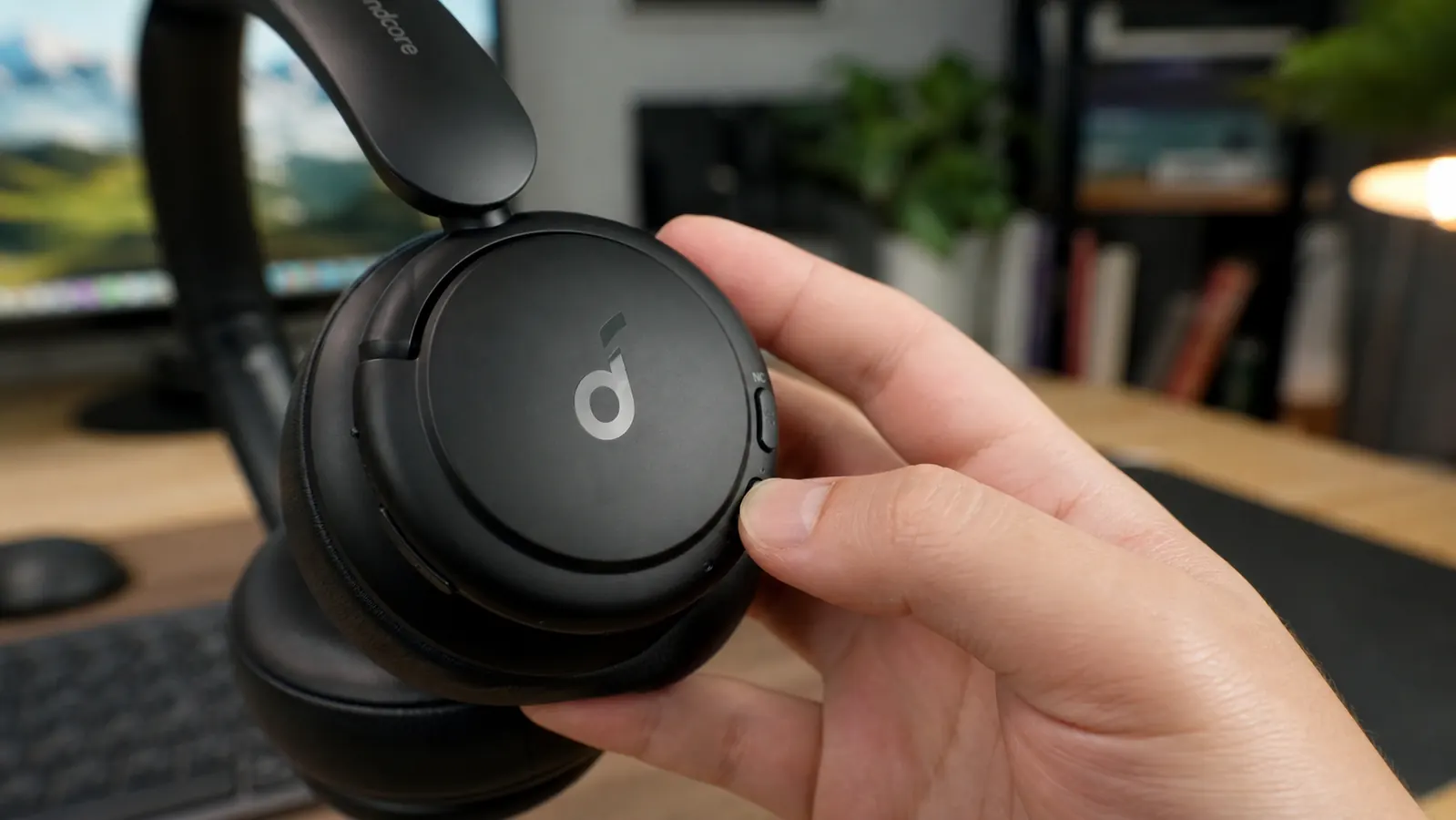
The physical controls matter more than I expected too. The Q30 uses real buttons on the ear cup, one for power and pairing, one that cycles ANC modes, plus a volume rocker. I can find all three by feel without pulling up an app or squinting at a touch panel, which matters when I'm mid-sentence on a call and need to switch modes without a five-second fumble. Touch-based controls on other headphones I've owned have fired accidentally just from adjusting the headband, and the Q30's buttons never have.
Where the Bose QuietComfort 45 Wins
I'm not going to pretend the Q30 matches Bose on raw ANC performance, because it doesn't. Bose's noise cancelling is built around a level of low-frequency rejection that's genuinely harder to notice as an active process, it just quietly removes the rumble of an HVAC system or a passing truck in a way that feels effortless. The Q30 does a very good job on those same sounds, but if you put both pairs on back to back in a loud environment, most people notice the Bose pulls a little more of the low end out. It's a real, measurable difference, it's just smaller in daily practice than the price gap implies.
Call quality is the other honest gap. On a windy patio or in a room with a running dishwasher, the QuietComfort 45's microphone array does a noticeably better job isolating my voice from the background than the Q30's does. In a quiet home office with the door shut, I can't tell the difference on a call. The moment there's real ambient noise on my end, the person on the other side of a Bose call hears me more clearly than they do on a Q30 call. If most of your calls happen from a genuinely quiet room, this gap won't matter to you. If you're calling from a kitchen, a shared space, or with kids around, it might.
Weight is a smaller factor but it's real over long sessions. The QuietComfort 45 is about 2 ounces lighter, and on days when I'm wearing headphones for 7-plus hours straight I do notice the Q30 sitting slightly heavier on my head by the late afternoon. It's not uncomfortable, the clamping force is well distributed and the ear cups are plenty padded, but if you're especially sensitive to headphone weight over marathon sessions, the Bose has a real edge here.
Bose also wins on the intangible stuff that's harder to put a number on. The hinges feel tighter, the headband padding compresses a little more evenly, and after eight months my Q30's left ear cup has developed a faint creak when I turn my head fast that a QuietComfort 45 owner I know still hasn't reported after two years. It's a minor annoyance, not a defect, but it's the kind of small manufacturing gap you're less likely to run into on a headset built to Bose's tighter tolerances.
Block out the household noise without the $250 markup
The Soundcore Q30 handles the noise sources that actually interrupt a workday, vacuums, dogs, leaf blowers, at a fraction of what a premium brand headset costs.
Amazon Check Today's Price on Amazon →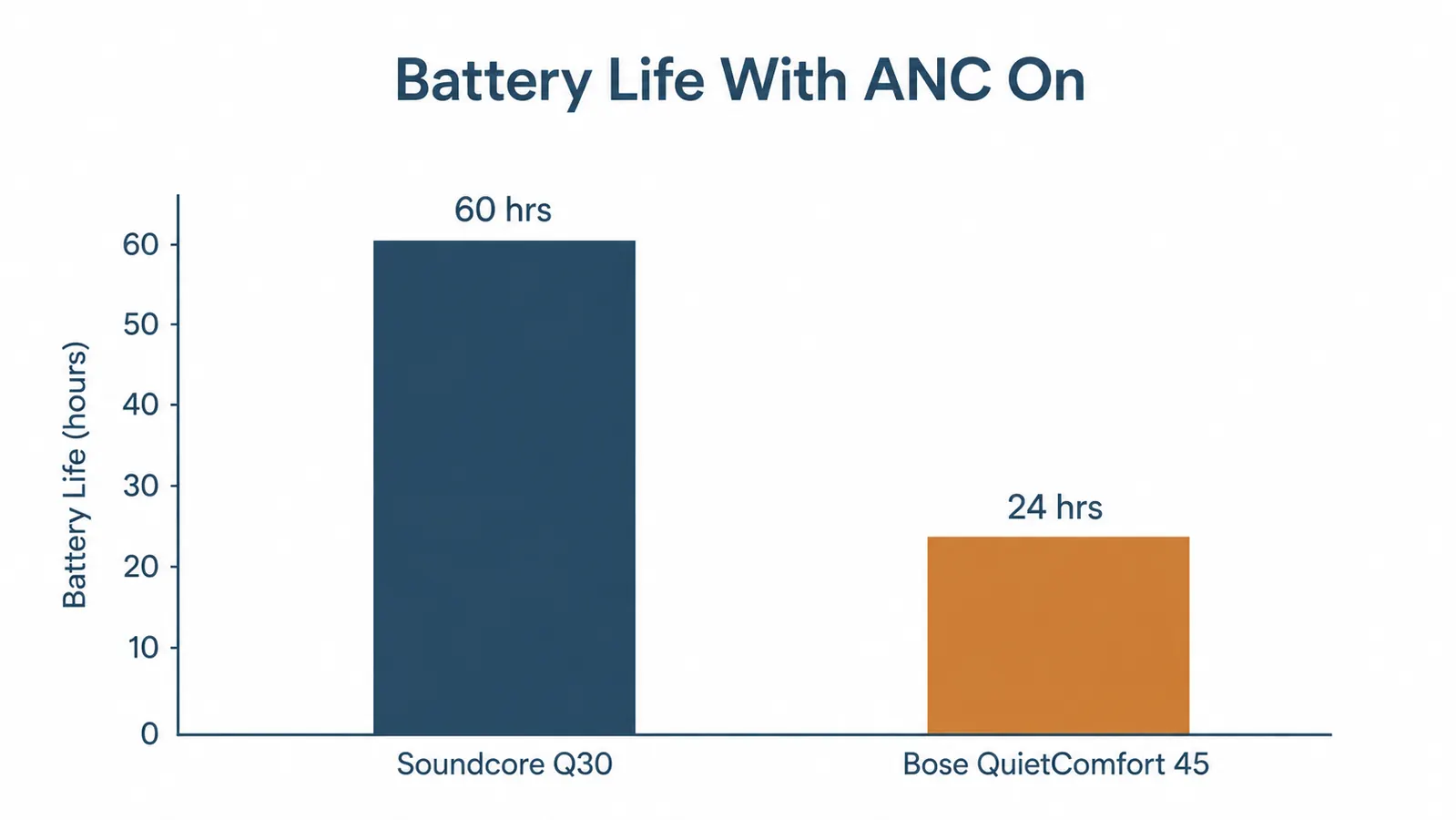
The Five-Year Cost-of-Ownership Math
This is the part that actually changed my decision, more than any single spec. Headphone ear pads wear out, hinges loosen, and batteries degrade over years of daily use, no matter the brand. At the Q30's current price, I could replace the entire pair three separate times over five years and still land under what a single QuietComfort 45 costs upfront. Even accounting for the fact that Bose's build quality likely means one purchase lasts the full stretch, that's a real bet you're making on longevity that a budget pair doesn't require you to make.
I also looked at what happens if a pair gets lost, sat on, or left on a plane, all things that have happened to headphones in my house before. Losing a $56 pair stings for a day. Losing a $300 pair changes how carefully you use them, which for me meant leaving the Bose in its case more often out of caution, ironically making it less useful as a daily tool rather than more.
There's a replacement-parts angle too. Ear pads on both pairs eventually flatten out after a year or two of daily compression. Soundcore sells replacement pads for the Q30 for around ten dollars, which is a rounding error against the original price. Bose's official replacement pads for the QuietComfort line run closer to thirty, still reasonable on their own, but stacked on top of a much higher entry price, the total cost of keeping either pair fresh over several years tilts even further in the Q30's favor.
I didn't need headphones that would still impress an audiophile in 2036. I needed the leaf blower gone by my 10am stand-up.

Comfort Over a Full Workday
I've worn both pairs for a full 8-hour workday to see how they actually hold up, not just how they feel in the first ten minutes. The Q30's memory foam ear cups are generously sized and don't press on the outer ear even after several hours, but the clamping force is a touch firmer out of the box than the Bose. It loosened noticeably after the first month of regular wear, which matches what a lot of other long-term owners report, but if you have a larger head or wear glasses, expect a slightly snugger fit than the QuietComfort 45 in week one.
Glasses wearers specifically should know both pairs will create some pressure where the temple arms meet the ear cushion, that's true of nearly every over-ear headphone and not specific to either brand. In my experience the Bose's lighter clamping force makes this slightly less noticeable over a long day, which is really the same weight advantage showing up in a different form. Neither pair caused actual discomfort for me, but it's worth trying on if you already know glasses plus headphones has bothered you before.
Who Should Buy Which
If you're setting up a home office on a budget, working from a noisy shared space, or just trying to stop the dog and the delivery trucks from derailing your calls without spending three hundred dollars, the Soundcore Q30 covers the fundamentals well enough that the performance gap stops mattering day to day. That's who this site is built for, people fixing a specific daily annoyance, not chasing the last percentage point of audio fidelity. If you're on calls constantly from genuinely loud or windy environments where every ounce of call clarity matters, or you value build quality and brand-level polish enough to pay for it directly, the QuietComfort 45's extra cost buys you real, measurable improvements the Q30 can't fully match.
There's also a middle case worth mentioning, someone who travels a lot for work and wants the best possible ANC on flights specifically. For pure flight noise, Bose's low-frequency cancellation has the edge, and if that's a weekly reality rather than an occasional trip, the difference is worth paying for. For daily home office use, that same edge shows up far less often than the price tag would suggest.
For most people asking this exact question, the honest answer is that the QuietComfort 45 is the more refined pair of headphones, and the Q30 is the smarter purchase. There's a real, measurable difference between the two, and it's worth sitting with before you spend nearly six times more on a pair of headphones for a room you might reorganize again in a year.
See why the Q30 is the pick for most home offices
Sixty hours of battery life, multipoint Bluetooth, and hybrid ANC that handles real household noise, without the premium-brand markup.
Amazon Check Today's Price on Amazon →