

I'm forty-one, I've worked from home for ten years, and for three of those years my desk chair was a budget dining chair with a rolled-up towel wedged behind my back. That's not a joke, that's what I actually sat in from 2022 to early this year while I told myself I'd deal with it later. Later showed up as a dull ache across my lower back by 2pm most days, and by month two of a new contract that had me on video calls from 8am to 5pm, the ache had turned into something I noticed standing up too.
I bought the SIHOO B100 PRO in February, mostly because it was the highest-rated mesh chair in the mid-price range that had an actual adjustable lumbar mechanism instead of a fixed foam bump. I've now sat in it roughly nine hours a day, five days a week, for six months straight. This review is what happened, including the parts that annoyed me, because I've read enough five-star reviews on Amazon that read like they were written the day the box arrived, and I don't trust those anymore.
The Quick Verdict
A genuinely adjustable, well-built ergonomic chair that fixed my lower back pain within six weeks, held up to daily use, and costs a fraction of the premium chairs it borrows ideas from.
Amazon Check Today's Price →If your back hurts by 2pm, your chair is probably the problem, not your posture
I spent three years blaming myself before I tried an actual ergonomic chair. Check today's price on the SIHOO B100 PRO and see if it's in stock in your color.
Amazon Check Today's Price on Amazon →How I've Used It
I run a small content business out of a spare bedroom in Columbus, Ohio, at Best Home Office Setup Hub we get this question constantly: does an ergonomic chair actually do anything, or is it marketing dressed up as physical therapy? I wanted a real answer, so I tracked it. Every Friday for six months I rated my lower back discomfort on a 1 to 10 scale at the end of the workday, using the same rough method a physical therapist gave me years ago for a different injury.
My desk setup is a 48-inch IKEA sit-stand desk, a 27-inch monitor on a separate arm, and a laptop off to the side for a second screen. I'm 5'10", 175 pounds, and I sit in roughly forty-five-minute stretches before getting up, which is a habit I built after a wrist injury made me start using a kitchen timer. None of that changed when the chair arrived. The chair was the only variable.
Assembly took me about thirty-five minutes on a Tuesday evening, mostly because I stopped twice to check that I'd attached the armrests to the correct side. The B100 PRO ships with the gas lift cylinder, base, and casters separate from the seat and back, and the instructions are diagrams only, no written steps, which is fine if you've built furniture before and mildly annoying if you haven't. I also swapped the stock hard casters for a set of soft rubber ones I already owned, since my office is hardwood and the stock casters are built more for carpet.
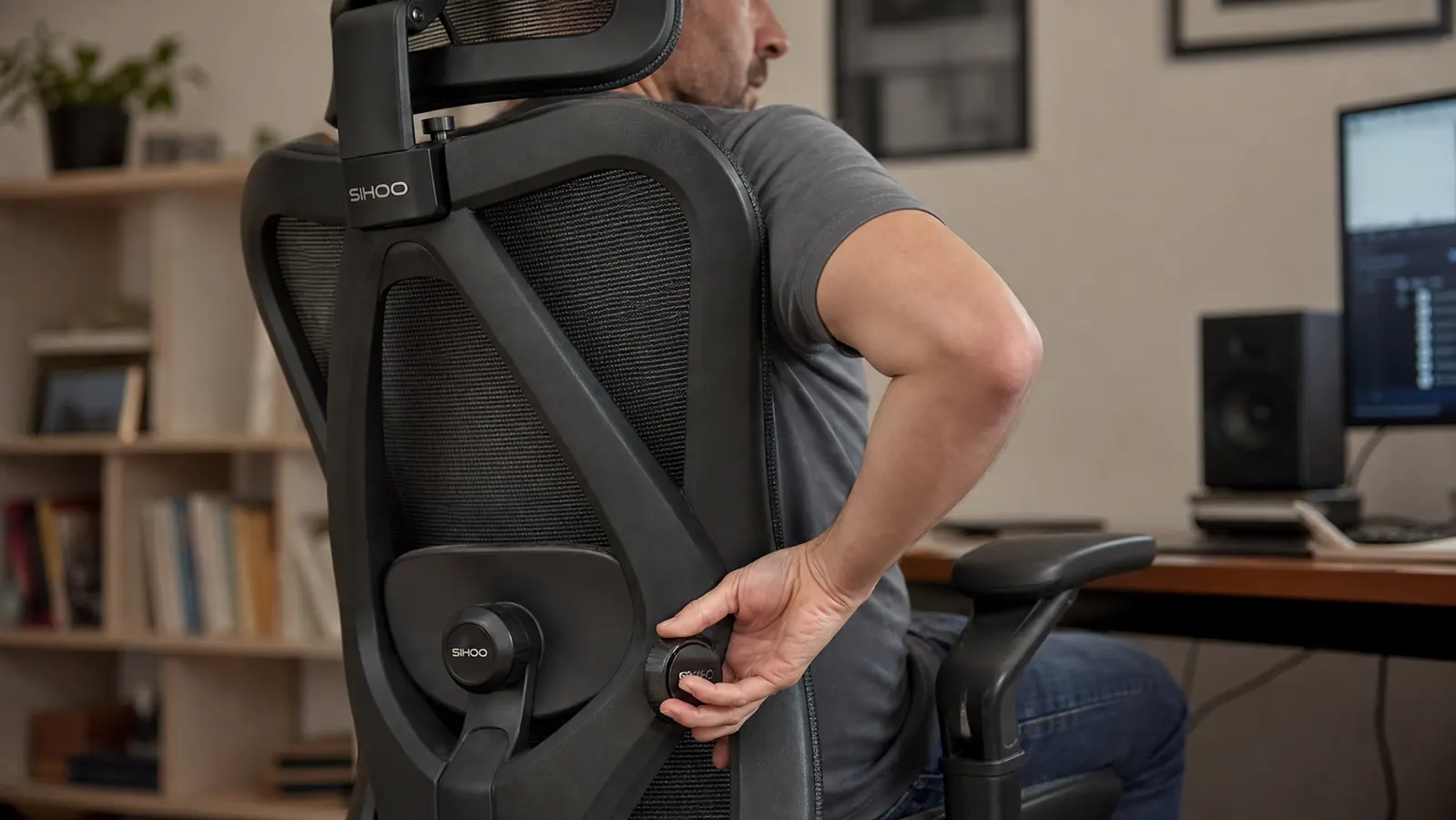
Adaptive Lumbar Support, Explained (and Whether It's Worth Caring About)
"Adaptive lumbar support" is the phrase doing the most marketing work in SIHOO's listing, so I want to be specific about what it actually is. It's a dial on the lower back of the chair that lets you rotate a curved support pad both up and down along a track and in and out toward your spine. That's it. It's not motorized, it's not sensor-based, it's a mechanical adjustment you dial in once and mostly leave alone.
For me that meant about ten minutes on day one, standing next to the chair, sitting down, reaching back, turning the dial, sitting back down, and repeating until the pad sat right at the curve above my belt line instead of between my shoulder blades, which is where it started. Once I found that spot, I didn't touch it again for six months. My wife used the chair for a week while her office chair was in for repair and had to redial it for her height, which took her about the same ten minutes.
The mesh back itself has some give to it, so even with the lumbar pad set, the backrest isn't rigid. It flexes a little as you shift, which is more comfortable over a nine-hour day than the fixed foam back on my old office chair from a previous job, which stayed exactly the same shape whether I was leaning forward typing or slumped back on a call.
The Footrest and the 4D Armrests
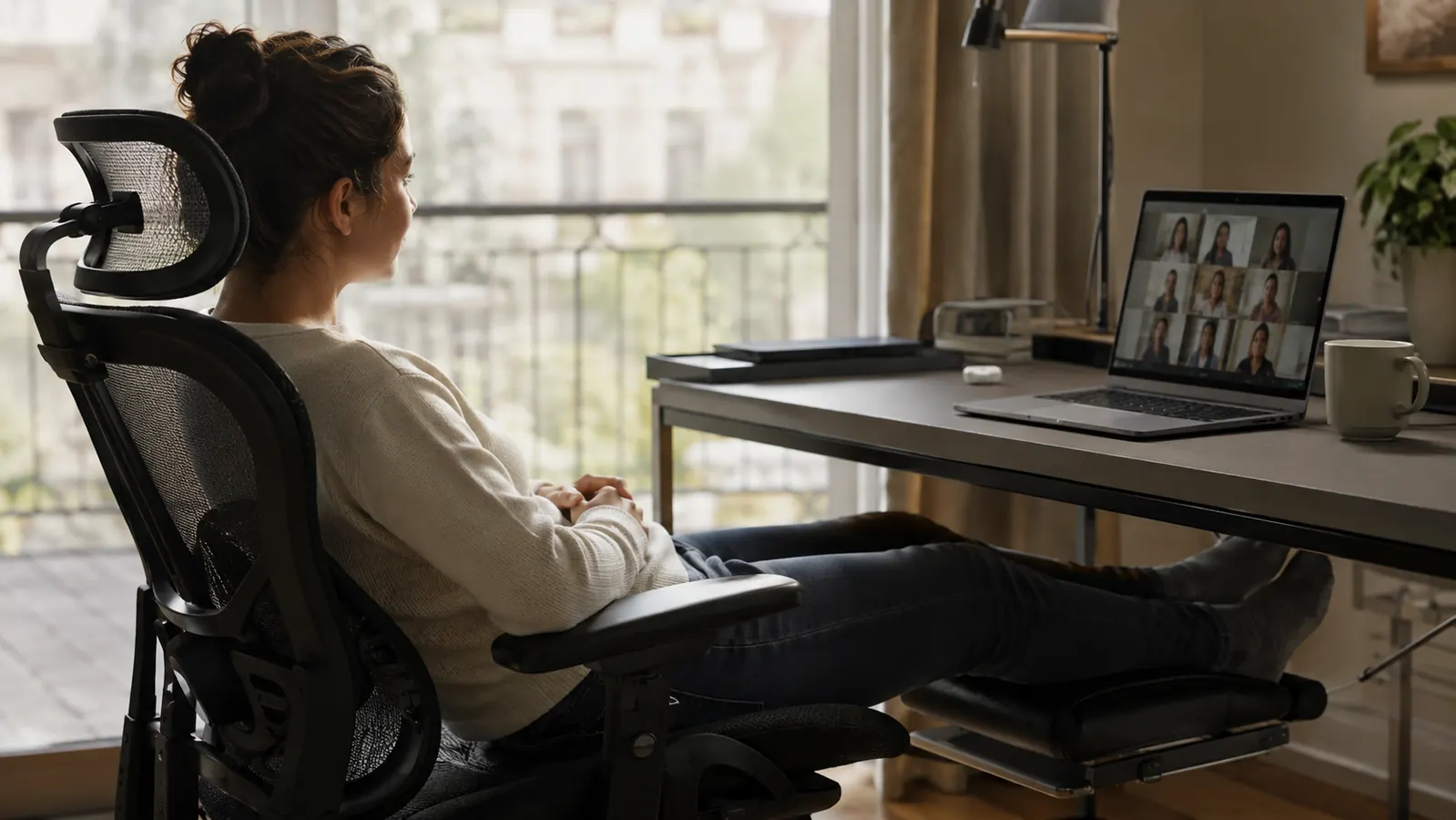
The pull-out footrest is the feature I was most skeptical of and now use almost daily. It tucks under the front of the seat and slides out on a track, then flips up to a slight incline. I use it maybe twice a day, once mid-afternoon when I'm on a call with the camera off and I want to recline and rest my feet, and once toward the end of the day when my lower legs feel stiff from being in one position too long. It's not something you'd use while actively typing, the geometry doesn't work for that, but as a fifteen-minute reset button it's genuinely useful.
The armrests move in four directions, up and down, forward and back, side to side, and they pivot slightly inward. I set mine once to match my desk height and mostly forget they're adjustable, except when I'm using the trackpad instead of a mouse and want them rotated in a bit closer. They're padded, not the hard plastic kind, and after six months there's no wobble or looseness in the adjustment joints, which is more than I can say for a budget chair I owned in 2021 that had wobbly armrests within two months.
Build Quality and Weight Capacity
SIHOO lists the B100 PRO's weight capacity at 300 pounds, and the frame feels like it's built for that, not just rated for it on paper. The base is a five-point steel star rather than plastic, the gas lift is a Class 4 cylinder according to the listing, and the seat pan doesn't flex or creak when I lean hard to one side to grab something off the floor, which is a habit I have that's broken cheaper chairs for me before.
The recline mechanism locks at four positions and also has a free-float mode, which I use more than the locked positions honestly. I keep it in free-float most of the day so the chair rocks slightly with me as I lean forward to type and back to think, instead of holding one fixed angle. The tension knob under the seat controls how much resistance that recline has, and I had to tighten mine two full turns from the factory setting to stop myself from tipping too far back at my weight.
Six Months In: What's Held Up and What Hasn't
The mesh has stretched very slightly where I sit most, which is normal for any mesh chair and hasn't affected support that I can feel. The gas lift still holds height with no drift, the casters roll smoothly on my hardwood floor with no squeak, and the recline tension knob still holds tension the way it did on day one. I weigh the chair down for nine hours a day, five days a week, which is more punishment than most home office chairs see, and I haven't had to tighten a single bolt since assembly.
The one thing that's loosened slightly is the headrest angle adjustment. It still locks in place, but it takes a firmer push than it did in month one to click into a new angle. It's a minor annoyance, not a failure, and I only noticed it because I readjust the headrest constantly depending on whether I'm on a call or reading on a second monitor.
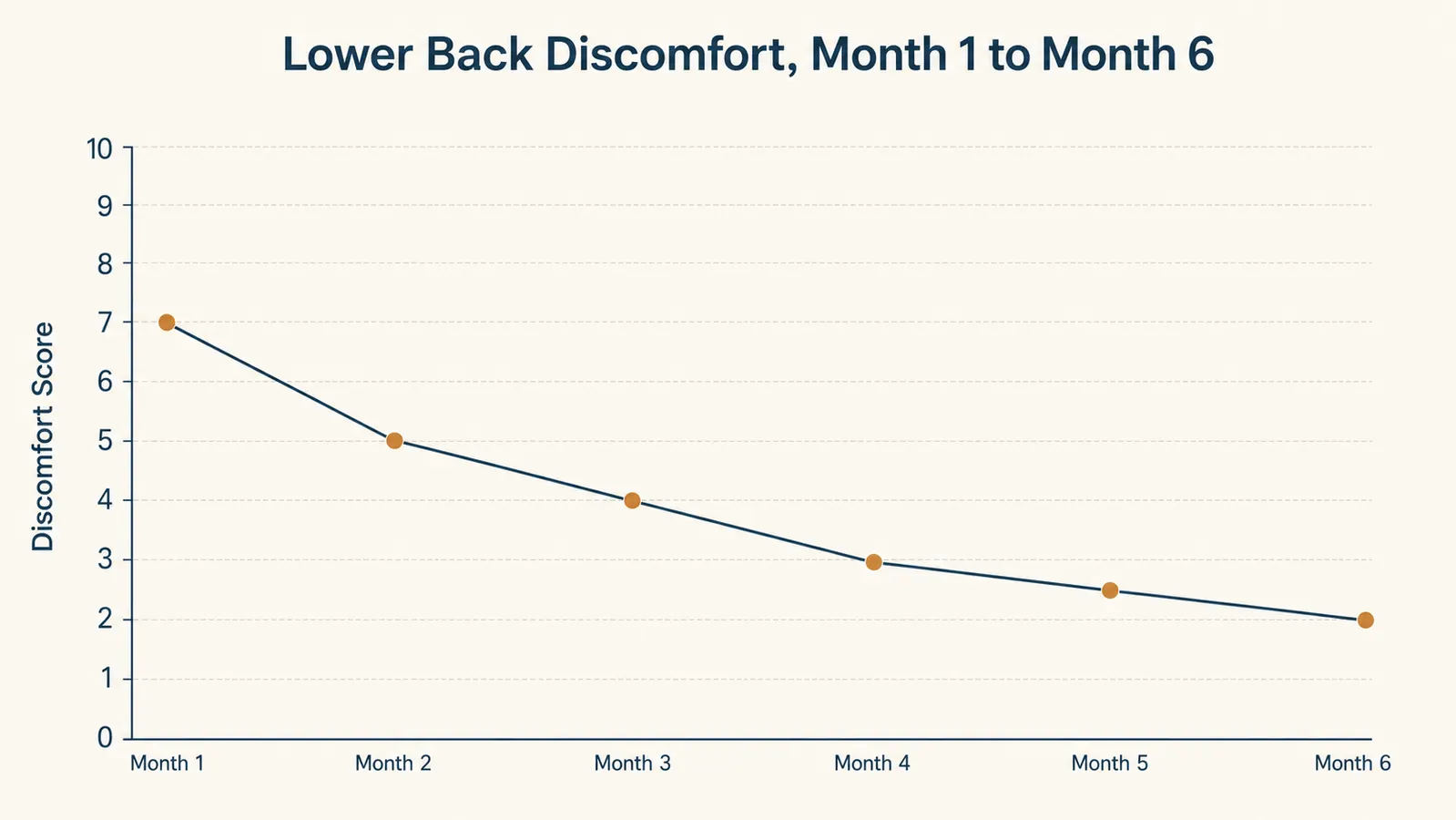
My discomfort score dropped from a 7 in week one to a 5 by week three, a 3 by week six, and it's sat between a 1 and a 2 for the last three months. I want to be honest that some of that improvement is probably from sitting properly for the first time in years, not the chair alone, a budget dining chair with correct posture would likely help too. But I didn't sit properly on the dining chair for three years, and I do on this one, mostly because the chair makes proper posture the easy default instead of something I have to consciously hold.
Where It Falls Short
The seat cushion is on the firmer side. I don't mind it, but a coworker who tried my chair for an afternoon described it as "stiff" compared to her cushier fabric task chair, and I think that's a fair read. If you're used to a heavily padded seat, the first week will feel different, not worse necessarily, just different, and it took me about ten days to stop noticing it.
The headrest, while adjustable, doesn't tilt forward and back independently of the up-down slide, so if you're tall or short outside the average range, you may find the angle isn't quite right even once the height is. I'm 5'10" and it works fine for me. A friend who's 6'3" found the headrest sat slightly too low even at max height, which pushed him to skip using it and rely on the tall backrest alone.
What I Considered Instead
Before buying, I looked seriously at two other options. A Steelcase Series 1, refurbished, was expensive and had a smaller, more compact frame that I worried wouldn't suit my longer torso. And a generic budget mesh chair from a brand I'd never heard of had almost no adjustability beyond seat height, which felt like solving one problem while ignoring the actual cause of mine, which was lumbar position, not seat height.
I also test-sat a used Herman Miller Aeron at a friend's office for about twenty minutes. It was noticeably more refined, the recline felt smoother and the mesh had a softer weave, but it was also a premium chair depending on size and condition, and I couldn't justify roughly three times the price for a difference I mostly felt in the first five minutes and stopped noticing after that.
The B100 PRO landed in the middle: more adjustability than the budget option, meaningfully cheaper than the premium option, with a five-year warranty on the frame and gas lift that gave me enough confidence to commit without testing it in a showroom first.
What I Liked
- Adaptive lumbar dial actually relieved my lower back pain within six weeks
- Pull-out footrest is genuinely useful for afternoon resets, not a gimmick
- 4D armrests and gas lift show zero looseness after six months of daily nine-hour use
- Mesh back breathes noticeably better than my old foam chair in a warm room
- Steel five-point base feels rated correctly for its 300-pound weight capacity
- Five-year frame and gas lift warranty
Where It Falls Short
- Seat cushion runs firm, takes about a week to adjust to
- Headrest angle has loosened slightly and needs a firmer push to reposition
- Headrest height maxes out a bit low for users over 6'2"
- Assembly instructions are diagram-only, no written steps
I didn't need a chair that looked impressive on a call. I needed a chair that let me forget my back existed for nine hours a day. This one does that.
Who This Is For
If you're working from a dining chair, a folding chair, or a hand-me-down office chair with no lumbar adjustment and you sit for six or more hours a day, this is a real upgrade, not a lateral move. It's also a good fit if you've outgrown a bargain mesh chair and want the next tier up without spending premium-brand money. Anyone dealing with a mild, posture-related lower back ache rather than a diagnosed spinal condition is the person I'd point toward this chair first, and it's held up well for both a 175-pound frame like mine and a heavier build like my brother-in-law's, who's closer to 240.
Who Should Skip It
If you have a diagnosed back condition, talk to a physical therapist before buying any chair based on a review, mine included. If you're under 5'4" or over 6'3", try to sit in one in a showroom or a friend's office first, since the seat depth and headrest range have real limits at the edges of that height range. And if you're only at a desk two or three hours a day, the price difference between this and a basic ergonomic chair probably isn't worth it for your use case.
Six months, nine hours a day, and my back stopped hurting by week six
That's the honest version of this review. If your current chair is doing more damage than good, see today's price on the SIHOO B100 PRO before your next long call.
Amazon Check Today's Price on Amazon →